
When belonging feels displaced and the fixed point you were measuring from is gone.
There is something that happens when you go back.
Not the first time. Not the visits when everything is celebration and you are so glad to be there that the gaps don’t register. I mean the later visits. The ones where you arrive with the full intention of feeling at home, and you find that the place has continued without you.
The neighbourhood has changed. The people you knew have their own full years in them. The ease you were expecting, the way you thought it would feel to simply be back doesn’t quite arrive. And somewhere in that first day or two, something lands that is hard to name.
You are, in some way you weren’t prepared for, a visitor.
That realisation is one of the quieter shocks of building a life somewhere new. Not the leaving, the going back and finding that the home you were holding in your mind no longer exists in the form you were holding it.
Why does going back feel so disorienting?
Most people who leave a country carry a version of the place they left. Not a photograph, something more internal. A sense of how mornings feel there. The particular way a room fills with people. The things that go without saying. The version of yourself who knew exactly how to be in that world without thinking about it.
That internal version becomes a fixed point. The thing you are measuring from. The place you return to in your mind when this life feels demanding, or foreign, or simply far from where you started.
And it is real. It was real when you left and it stays real. But it is also, slowly, becoming historical. A record of a place at a particular moment in time. And the place itself, the actual streets, the actual people, the actual rhythms has moved on.
When those two things meet the internal version and the actual place, there is a gap. And the gap can feel like loss.
Not the grief of something sudden. The quieter grief of realising the fixed point was never fixed. That the place you have been homesick for doesn’t exist in the form you have been missing it. That you cannot go back to it, not really, because the ‘it’ you were going back to was partly something you were carrying inside yourself all along.
“The home you were homesick for was real. What you find when you return is that it has kept moving without you — and the gap between the place you were holding and the place you are standing in is its own kind of loss.”
What does it feel like to not belong fully anywhere?
What follows that realisation is something I hear described in many different ways. Floating. Unlocated. Neither here nor there. The sense of being slightly behind the glass of wherever you are.
Not unhappy. Not ungrateful. Just… displaced.
Because here, in the life you have built, the one that works, the one you chose and you are still navigating. Still the person who knows this world in a particular way, from the outside in, having learned it rather than absorbed it. Still the one who occasionally gets a reference wrong or holds a slightly different assumption about how things work. Fluent in this world. But fluency isn’t the same as home.
And there, the place you came from you no longer quite fully belong either. You are loved there, welcomed but you are also the one who left. Who built a life elsewhere. Who has, in ways large and small, become someone shaped by another place.
Two worlds with a claim on you. And not being able to be fully present in either one at the same time.
That is displacement. Not a phase, not a failure to integrate, not something time straightforwardly resolves. It is the honest structural condition of a life built across more than one world. And it can sit, unnamed, underneath an otherwise good life for years.
Why do I feel like nobody sees the full version of me?
Here is something that takes time to understand about displacement. It is not only about the place.
It is about being known.
The people in this life know the version of you that lives here. The people back there know the version of you that grew up there. But the person who contains both, who has been shaped by all of it, who carries all the places and all the versions and all the years – that person often doesn’t have a community of people who see the whole picture.
You are known in fragments. Partially here, partially there, fully nowhere.
That is its own kind of loneliness. Not the loneliness of being without people, you may be completely surrounded by people who care about you. But the loneliness of carrying a self that is larger than any single context can hold. Of never quite being in a room where all of you arrived.
And the cost of that, over time, is quiet but real. The low-grade work of deciding, every time you walk into a room, which version of yourself to bring. The editing that happens before you’ve spoken. The stories are told at a surface level because the full version requires context that would take longer to give than the conversation allows.
None of this is dramatic. None of it shows. That is partly what makes it so tiring.
“The loneliness of displacement isn’t about being without people. It’s about carrying a self that is bigger than any single context can hold. Of never quite being in a room where all of you arrived.”
Will the feeling of displacement ever go away?
There is something well-meaning but not quite right that gets said to people navigating this.
Give it time. You’ll settle. It gets easier.
And parts of it do. The practical disorientation of early migration, the navigating of new systems, the building of a social world, the process of learning where things are and how things work, that does ease. Most people do build real, rooted lives. They do find belonging, in forms they didn’t necessarily expect.
But the displacement underneath that, the sense of being between worlds, of carrying more than any single context holds, of the fixed point having moved that doesn’t resolve in the same way. Because it isn’t a practical problem. It is a structural reality of a particular kind of life.
What can change is the relationship to it. Whether it is carried as something private and slightly shameful, a sign that you haven’t settled enough, haven’t integrated enough, aren’t grateful enough for what you have or whether it is held as an honest description of what is actually true.
Those two versions cost very different things to live with.
What does belonging look like when you live between cultures?
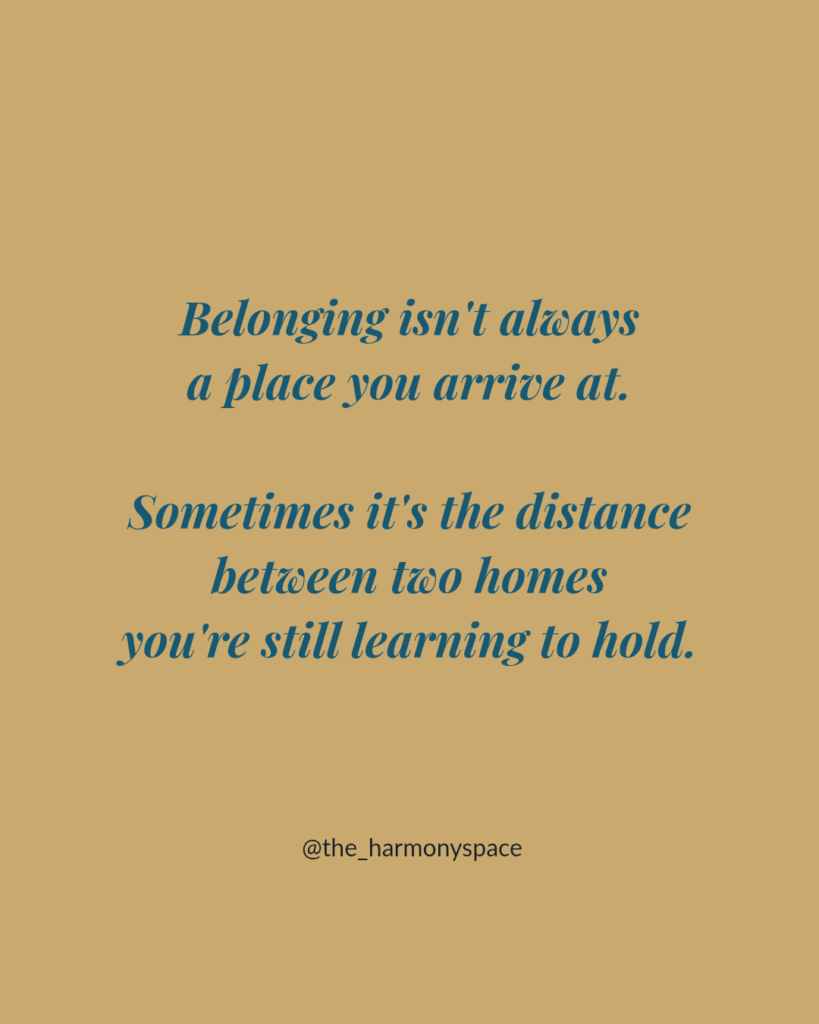
For people who live in this condition, belonging tends not to look like a place.
It looks like moments. Specific rooms, specific conversations, specific people in whose presence the full version of yourself shows up without editing. Someone who shares enough context that you don’t have to start from the beginning. A friendship built on genuine recognition that crosses the cultural lines entirely. A conversation that holds all of it without needing to simplify any of it.
It is partial. It is contextual. It moves.
And learning to recognise it, rather than measuring every experience against a version of belonging that may not be available in the form you once knew it, is some of the most important and underrated work of a displaced life.
This is not about lowering expectations. It is about understanding that belonging, for someone shaped by more than one world, was never going to look the same as it does for someone who has only ever lived in one place. That is not a deficit. It is a different kind of life, with a different kind of belonging available to it.
Worth naming. Worth sitting with. Worth bringing somewhere, rather than carrying alone.
When should I seek support for feeling displaced or unlocated?
If you have been carrying a quiet sense of being unlocated, a life that works and something that still feels like it hasn’t quite landed this might be worth naming somewhere.
Not to fix it. But because things that never get named tend to become background noise. Something you adjust around rather than something you actually bring into the conversation. And there is a real cost to adjusting around something quietly for a long time.
You might also find something in the writing on the grief that doesn’t come with permission to name it, or on why you don’t have to choose between the feelings that seem to contradict each other. [Link: The Grief Nobody Names / Two Things Can Be True at the Same Time]
If a free 20-minute conversation feels like a useful place to begin no referral, no wait list, no label required first
Frequently Asked Questions
What is displacement after migration?
Displacement after migration refers to the feeling of not quite fully belonging anywhere — not in the new country, and no longer fully in the country you left. It isn’t always about hardship. It can arrive after things have gone well, when you’ve built a real life somewhere new but still carry the sense that part of you lives elsewhere.
Why do I feel like a visitor when I go back to my home country?
When you live somewhere new for a significant time, your home country continues without you. The place changes, relationships deepen in your absence, and the internal version of home you’ve been carrying becomes historical rather than current. Going back and finding this gap is one of the quieter losses of migration — the realisation that the home you were homesick for has moved on.
Is it normal to feel like I don’t fully belong anywhere after moving countries?
Yes — and it’s more common than people say. Living between two cultures means navigating two worlds that both have a claim on you, without being able to be fully present in either at once. This isn’t a sign you haven’t integrated well enough. It’s an honest description of what it costs to build a life across more than one world.
Can counselling help with feeling displaced or between worlds?
Yes. Counselling that is culturally informed can help you understand the displacement you’re carrying, find language for experiences that haven’t had it, and relate to the in-between differently. At The Harmony Space, I work with adults navigating cultural identity and displacement online across Australia, and in-person in Western Sydney. Sessions available in English, Hindi, and Gujarati.
How do I find belonging when I live between cultures?
Belonging for people who live between cultures often doesn’t look like a single place. It shows up in specific conversations, relationships, and rooms where you don’t have to edit yourself or start from the beginning. Learning to recognise those moments — rather than measuring them against a version of belonging that may no longer be available — is some of the most meaningful work of a displaced life.