On the pause that happens before you tick the box and everything it holds.
There is a particular kind of pause that happens when a form asks for your cultural background.
It is not confusion, exactly. You know the options. You have read them before. And yet something in you hesitates hovering over the choices, aware that none of them quite holds what you are about to put into them.
You tick something. You move on. But the pause stays with you.
That pause is what this piece is about.
Why does someone else get to decide what my cultural background is?
Long before any form, most of us have already been handed a category.
Sometimes it arrives from the outside the world reading something visible about you and deciding, before you have spoken, where you belong. Sometimes it comes from closer in your own community drawing a quiet line around what counts as authentic, what counts as ‘enough’ of a particular culture, who qualifies and who sits at the edges.
Both carry the same undertow: someone else has decided who you are. Your job, it seems, is simply to fit the description.
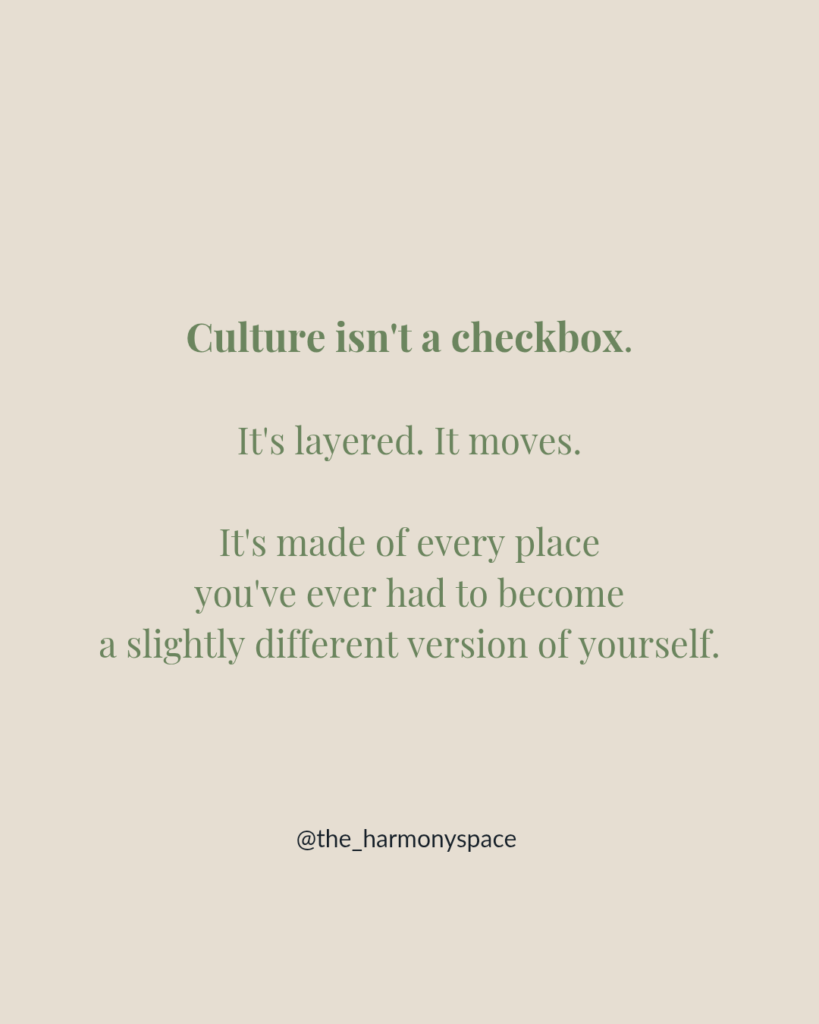
The problem is that identity doesn’t work like a label. It was never a fixed thing to be assigned and carried unchanged across borders. It is something lived shaped by every place you have been, every version of yourself you have had to become, every room that asked something different of you.
A label was made for a simpler version of you. It doesn’t account for the cities. The languages. The years.
“Someone else has decided who you are. Your job, it seems, is simply to fit the description.”
What does it mean to live between cultures?
For people who have moved countries or grown up between them there is a particular kind of in-between that doesn’t resolve itself neatly.
There is the version of you that belongs to where you came from. The version that has learned to navigate where you are now. And the version that lives in between — fluent in both worlds, and fully at home in neither.
This is not a failure of integration. It is not confusion or displacement. It is the honest complexity of a life lived across more than one place, more than one set of expectations, more than one version of yourself. And for many adults navigating this across Australia — in Western Sydney, online, across time zones from family — this complexity rarely has a name.
And it is not only migration that creates this. Globalisation has built its own kind of in-between for people raised in intercultural families, in friendships that crossed borders before they did, in communities where the values at home and the values outside were never quite the same.
There is a particular grief in this that often goes unnamed. Not the grief of a death or a clear ending, but the quieter kind the loss of a version of yourself, a language slowly losing its muscle memory, a home that no longer exists in the way you remember it. If that resonates, you might find something useful in The Grief Nobody Names, a reflection on the losses that don’t come with permission to mourn them.
The form still asks you to tick one box. But you are not one box.
Can I feel proud of where I am and still grieve what I left?
One of the more disorienting parts of living between cultures is that you can hold genuine love for a place, a community, or a way of life — and still feel the weight of what it asked you to leave behind.
You can be proud of how far you have come and still ache quietly for the person you were before all the coming-far was required. You can feel grateful for the life you have built and still carry something unresolved about the life you left, or the version of yourself that stayed behind.
These are not contradictions. They are the honest complexity of a layered life. Two Things Can Be True at the Same Time — on grief and gratitude, love and loss, and why you don’t have to choose sits alongside this piece if you find yourself holding both.
“The form still asks you to tick one box. But you are not one box.”
What does real belonging look like for someone shaped by more than one culture?
Belonging is not the same as fitting the category.
Belonging real belonging is being seen with all of it. The layers. The contradictions. The in-between. The version of you that only exists in certain rooms, speaking a particular language, around particular people who don’t require an explanation.
That kind of belonging is harder to find. It often requires intentional community. And sometimes it requires support to even name what has been missing because when you have spent years performing clarity about who you are, it can take time to admit that the performance was tiring, and that underneath it, something was quietly searching.
This is some of the most meaningful work I sit with supporting adults in Western Sydney and across Australia, online, who are navigating questions of cultural identity, belonging, and the versions of themselves that have never quite had a space to land. I offer sessions in English, Hindi, and Gujarati, and I work with adults who live between languages, cultures, and expectations.
Do I need to have it figured out before I reach out for support?
Sometimes people come to therapy with a clear sense of what they want to explore. More often, they arrive with a feeling they can’t quite name yet — a low-grade ache, a sense of something missing, an exhaustion that rest doesn’t touch.
If you’ve been thinking about reaching out for a while but something keeps stopping you wondering if what you’re carrying is ‘enough,’ whether you’ll have the right words, whether this is even the right moment Thinking About Therapy? explores that gap directly. The short version: you don’t need a crisis, a diagnosis, or a perfectly formed sentence to begin.
You just need enough curiosity to take one small step toward yourself.
What question is worth sitting with when belonging feels complicated?
Not: which box do I fit?
But: what does belonging look like for someone shaped by more than one place, more than one community, more than one version of themselves?
That question deserves somewhere to explore it. Without being asked to simplify the answer. Without being handed a category before you have finished speaking.
The pause before the box the one that has been following you for years is not a gap in your identity. It is the most honest part of it.
If you ever want to explore that step, I offer a free 20‑minute introductory call. “No referral needed”.
Online counselling across Australia.In-person and walk-and-talk sessions in Western Sydney.
Frequently Asked Questions
What is cultural identity and why does it feel complicated?
Cultural identity is the sense of belonging that comes from being part of a cultural group — shaped by language, values, traditions, and the place you grew up. It feels complicated when you’ve lived across more than one culture, because no single identity fully captures who you are. That complexity is real and normal, not a sign something is wrong.
Why do I pause when a form asks for my cultural background?
That pause often means the honest answer is more layered than the options allow. You may belong to more than one culture, have moved countries, or feel that no single category captures your full experience. The pause isn’t confusion — it’s the most honest part of your identity.
Is it normal to feel like you don’t fully belong anywhere?
Yes — and it’s more common than it gets talked about. People who have lived between cultures, grown up in intercultural families, or navigated significant life transitions often experience a sense of partial belonging in multiple places. This isn’t a personal failing. It’s what identity looks like when you’ve been shaped by more than one world.
Can counselling help with cultural identity and belonging?
Yes. Counselling that is culturally informed can help you understand what you’re carrying, name experiences that haven’t had language before, and find a sense of self that holds all your layers rather than asking you to simplify them. At The Harmony Space, sessions are available in English, Hindi, and Gujarati, online across Australia and in-person in Western Sydney.